
“Pair this with the right observability” Langsmith 🔥
回复
名次由各坊自己计分,只给档位:塔尖 10% / 20% / 50%,过 60% 不排。各坊刻度不通约, 不合并、不加权、不给总分。
“Pair this with the right observability” Langsmith 🔥
@RimasXYZ I think it’s harder optically. I don’t think it’s happened to date. But may!
Models labs will create great harnesses and ecosystems for their models but will block model access to harnesses of other labs Only choice for a harness that works across models is one not associated with a lab Long live LangChain
@itscjzhao Cc @sydneyrunkle !
Follow @colifran_ for all things wiki! Wikis are a great way to represent knowledge in a simple and easy to understand way
@jit_infinity how would you want to integrate? to observe them? or more?
Would love feedback on our support for the new mcp spec!
this is why benchling will create the best ai agent for science, not ant/oai strongly believe in a many-agent world, each one domain specific
@_aakarim Oops ya
openwiki now supports okf 2.0
How we think about evaluating wikis Including whether wikis are actually even helpful!
Deepagents is becoming a multiplayer harness Auth, memory, etc If you’re building an agent that you want to expose to multiple users in same thread and are thinking about these issues - reach out! Would love to chat
@masondrxy @atbeme Because he built whip, and didn’t build the other ones /s
its relatively easy to generate a wiki the first time, but how do you update them reliably? openwiki v0.4.0 improves in this dimension - it "forgets" better
@forgebitz desktop app or web app or both?
trying to think about how to most easily create evals we launched a skill to help with this iterative process
Evals matter
A hard part of agents is connections - seems easy but hard to get right/seamless Managed deepagents tackles it for you More to come!
Open bot!
very cool launch we did a webinar with jeff on "wiki" style memory and it's clear he'd thought about this problem a lot (webinar here: https://t.co/2u3AIexV7t)
@verrsane We have multiple
@verrsane Come by the LC office
lots of observability & evals platforms not a lot of platforms that help close the loop and have an agent that suggests fixes, adds evals itself, etc
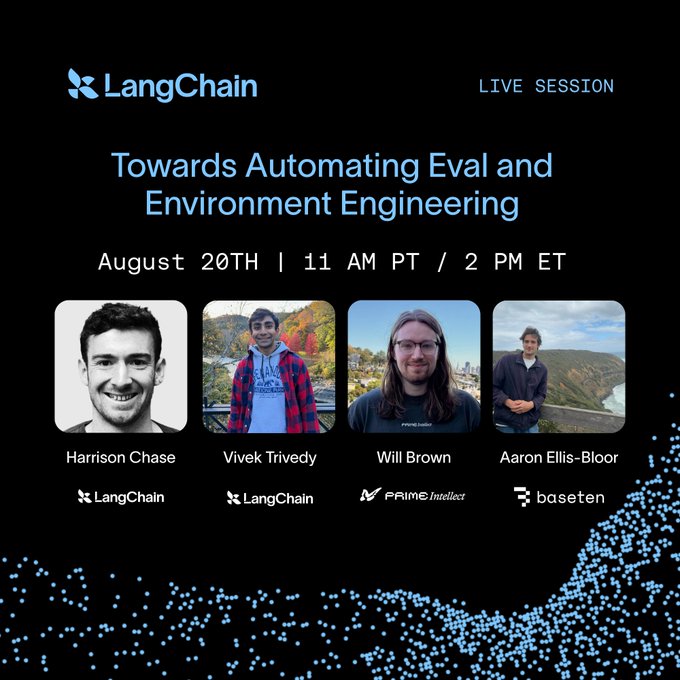
top tier webinar tmrw! @Vtrivedy10 (@LangChain) @willcb (@PrimeIntellect) @AEllisBloor (@baseten) and I will will be jamming on how to automate more parts of the agent improvement loop (eval and environment engineering in particular) Come join us: https://t.co/FixvTtPUgM https://t.co/h7MGxb1GrL
+1 to this part of this is due to coding agent standards - agents.md and skills are just markdown files/directories!
🎓New YouTube playlist: Managed Deep Agents Gives an overview of Managed Deep Agents, and then each video dives deep into core concepts. Launching with six videos! 1⃣ Intro: https://t.co/DD1J0vOr2D 2⃣ Conceptual Overview: https://t.co/CDs6ysKAax 3⃣ Quickstart: https://t.co/otB4xrCfNh 4⃣ Instructions and Context Hub: https://t.co/251flZZBZr 5⃣ Skills: https://t.co/rQtfQ8Jq28 6⃣ Tools: https://t.co/g1Fw8UEnj1 Playlist link: https://t.co/FRAWhAOwvB

new onboarding for managed deep agents
I love working with Sydney and team and you will too! Come join us
Slack is the best ux
@jeffrschneider right now mostly human
channels are how you interact with your managed deepagents eg slack pretty diagram 👇
@satyabratsingh it applies to the whole convo!
@sonilapt nice diagram
🚀Today we launched LangSmith Tuned Evaluators, starting with Perceived Error. Tuned Evaluators run on production traces to catch undesirable agent behavior and attach feedback that you can use in your agent improvement processes. In our benchmark, our tuned model beat frontier models at 82% lower cost. https://t.co/2df6i35SsY

@EbrahimElb Nice totally agree
totally agree! here's how we architected deepagents to enable this deepagents runs connected to a "backend". this backend needs to expose filesystem like operations, but it does not have to be a filesystem. it could be a database, object storage, or a real filesystem - it just has to expose read/write/edit etc operations this backend could also be what we call a "sandbox". if a sandbox, it needs to expose an "execute" command which lets it execute code this backend is SEPARATE from where the agent loop runs. this allows us to "separate the brains from the hands" (https://t.co/Pi3XljhB67) deepagents is built on top of langgraph, which means we can easily deploy it with MCP, a2a, and other standard endpoints we use this architecture to power many different types of experiences first, we can create a classic TUI like coding experience. we do this by giving deepagents a "sandbox" that is running locally in the same directory; deloying deepagents locally behind a light weight server; and then connecting to it with the TUI acting like a frontend. see dcode for an example of this https://t.co/wj48PbCuSx second, we can create a cloud coding experience. we can do this by running deepagents on LangSmith deployments for a production scale deployment, and connecting to a sandbox running on modal, daytona, e2b that is running elsewhere. we can then build a frontend to connect to langsmith deployments and let users interract with it there, and also expose it in slack to let users interract with it there. note: both slack and web ui connect to the same backend, so you can switch between them seamlessly. code: https://t.co/Pdevl2PRrv of course - deepagents can be used to create agents that are NOT coding agents. a lot of agents still need to write and execute code, so this architecture is still very useful. but for some the code execution is overkill, and thats where you can swap to a "fake" backend, and still let it have the ability to interract with files (good for context engineering!) without having to spin up a full sandbox. for a really easy way to create these types of agents - see managed deepagents: https://t.co/NAXiKqZbi1
@EliasLumer @sequoia @sonyatweetybird @FireworksAI_HQ i think it depends if off the shelf harnesses are good enough for your task!
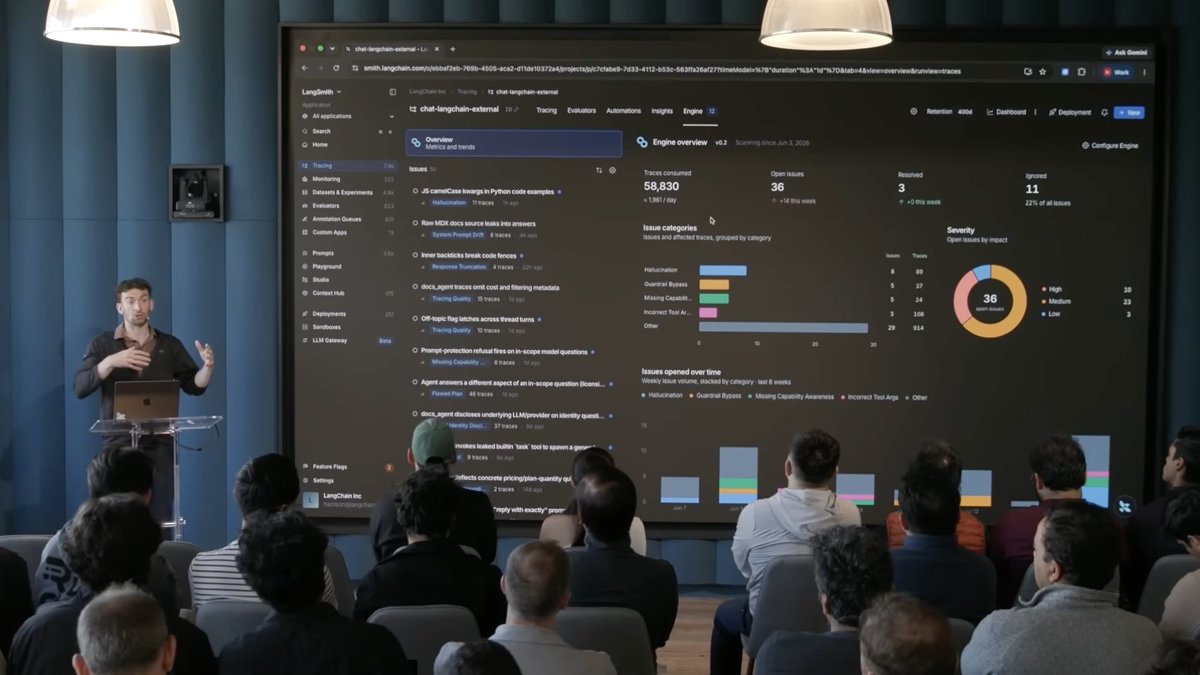
gave a talk "owning your intelligence" - ty @sequoia @sonyatweetybird for having me talked about harnesses and evals and the role they play in owning your intelligence TLDR: > agents = model + harness + context > model - own the weights using something like @FireworksAI_HQ > context - memory needs to be portable > harness - needs to be model agnostic. also needs to be good at bringing right context to llm. "right" context may depend on your use case, which is why an open/configurable harness helps > how to use middleware in langchain/deepagents to configure your harness > how to use langgraph to fully own your cognitive architecture > why evals/obs matters - some quotes from @satyanadella - “Create your private evals, because evals define what “good” looks like inside the organization” - “retain ownership of your organization’s memory, traces, feedbacks, decisions, and institutional context” - “you create your own continuous learning loop (i.e. hill climbing machine) that will allow your AI investments to compound the value of your firm” > how to use harbor for evals > tracing is important > evals + observability only matter so you can set up a data flywheel > data flywheel = run agent -> collect traces -> find interesting traces -> use those to improve > demo of langsmith engine which does exactly this! full video: https://t.co/k6li5hu6D9
1/2 - langgraph 3 - deepagents 4 - langsmith Welcome to the LangChain ecosystem
Open wiki is long term memory for your codebase
LangSmith Gateway! - cost controls (including for your end users) - rate limiting - data/pii redaction - integrates with coding agents! - access to OSS models like kimi-k3!
New Max Agency with @cognition President @russelljkaplan. We got into the saturation of SWE-bench and what Cognition built to replace it, why "which model is best" stopped being the right question for most teams, and more. ⏯️ YouTube: https://t.co/jzMl3pypSl 🎧 Apple: https://t.co/OTCKcXRSHz 🎧 Spotify: https://t.co/rbPJyLMtOo
this is a cool example of "dreaming" memory openwiki is a wiki for your codebase. on some schedule, a background process will run and look at your langsmith traces to see how coding agents *actually* interacted with your codebase and then will update the wiki!
deep agents 0.7!
✈️LangChain in London! We're going to be hosting our first ever Interrupt:London event this year! It will be October 13th at Outernet London We'll have launches, firesides, customer talks, workshops, and more Come join us :) https://t.co/L9HMn7zoXj
This is one of my fav episodes we’ve done - tons of harness talk
@yesprasad26 @ClementDelangue @OpenAI @LangChain Yes :) this is exactly why we build the ability to share traces publically!
@krinetix1234 Agree on all!
👀who wants this
@gb_neocarbone @JensenHuang @satyanadella Fair point! I think hosting yourself is the most extreme
@ChoubeyPrakalp @JensenHuang @satyanadella Nice blog!
@BTCD_BTC @JensenHuang @satyanadella It’s an underrated part
Every company that wants to build a business around AI will need to own their intelligence As @JensenHuang @satyanadella and others wrote yesterday, a huge part of that is open models But it’s more than that as well! This my take on what it means to own your intelligence
https://t.co/JdkAzhFLlA
@mahmad2b What would you want to do with per agent identity
Open wiki is about organizing your codebase’s knowledge - and to review this, a picture is worth a thousand words
@dragos_coj Thanks for surfacing! Passed on to team
Starting now!
Interrupt NYC is 2 months out we're starting to plan out some of our launches. At Interrupt SF we launched LangSmith Engine and SmithDB... what will we launch in NYC? 👀 we're also going to have a great set of speakers - register today! https://t.co/AqItAanndM https://t.co/mCT8uvWxBa